



If you've ever tried to move stablecoins off a rollup using the native bridge, you've probably hit the wall: your funds are locked in a 7-day withdrawal window, stuck in a challenge period you didn't fully anticipate, and completely unavailable for trading or deployment in the meantime.
For DeFi users who need liquidity to move fast across chains, in response to market conditions, without multi-day delays, the canonical bridge model is simply broken for real use cases.
This article breaks down the real differences between canonical bridges and FastBridge, why those differences matter for active DeFi participants, and when each type of bridge is actually the right tool for the job.
What Is a Canonical Bridge?
A canonical bridge is the official, protocol-native bridge of a blockchain network, typically an L2 rollup like Optimism, Arbitrum, or Base. It's built and maintained by the core team and serves as the primary mechanism for moving assets between the L1 (usually Ethereum mainnet) and the L2.
Canonical bridges are trustless by design. They rely on the underlying security model of the rollup itself, meaning withdrawals from L2 back to L1 are secured by the same cryptographic or economic guarantees that protect the chain.
That security comes at a cost: time.
How Canonical Bridges Work
For optimistic rollups (Optimism, Arbitrum, Base), the process looks like this:
- You initiate a withdrawal from L2 to the Ethereum mainnet
- The transaction enters a challenge period, typically 7 days, during which fraud proofs can be submitted if the state is incorrect
- After 7 days, if no challenge is raised, your funds are released on L1
For ZK rollups (zkSync, Scroll, Linea), the process is faster. Validity proofs can settle in hours rather than days, but still involve waiting for proof generation and finalisation windows.
Deposits (going from L1 to L2) are generally fast on canonical bridges. It's the withdrawal direction that punishes users.
Why is bridging crypto so slow?
Bridging is slow when a bridge has to wait out a security window before it will trust that a withdrawal is valid, rather than settling it immediately. On optimistic rollups, that means a 7-day challenge period during which fraud proofs can still be submitted. On ZK rollups, it means waiting for validity proofs to be generated and finalized, which is faster but still not instant. The delay isn't a bug, it's the trade-off canonical bridges make in exchange for trustless security.
The 7-Day Problem: Why It Breaks DeFi
Seven days is an eternity in DeFi. Markets move in minutes. Liquidity opportunities open and close in hours. A 7-day bridge withdrawal window doesn't just introduce friction; it actively prevents you from doing the things DeFi is built for.
Real scenarios where 7 days kill the trade
- You have $5,000 USDC on Arbitrum. A new yield protocol launches on Ethereum with high early APY. You can't react; your capital is locked in a withdrawal queue for a week.
- A price discrepancy opens between MegaETH and Ethereum. You want to arbitrage it. By the time your canonical bridge withdrawal clears, the opportunity is gone, and you've also paid 7 days of opportunity cost.
- You need stablecoins urgently on a different chain. An unexpected gas spike or protocol emergency requires you to move capital fast. The canonical bridge offers you no mechanism to expedite.
In each of these cases, the canonical bridge is technically working as designed. The problem is that its design was built for security guarantees, not for the speed requirements of active DeFi participation. Canonical bridges protect the chains. FastBridge protects your opportunities.
FastBridge: How It Solves the Speed Problem
FastBridge, powered by Avail Nexus, is the fastest way to move your assets across chains, instantly. Combine balances of any supported token from multiple chains into a single transaction, swap into the exact asset you need, and land on any of FastBridge's 12 supported chains instantly, with zero slippage and atomic settlement speed.
Instead of waiting for a challenge period to expire, FastBridge matches your transfer intent with a liquidity provider who fronts the assets on the destination chain immediately. The liquidity provider is then reimbursed on the backend, removing the delay entirely from your experience.
Because FastBridge now supports swaps as well as bridging, your source and destination assets don't need to match either. You can bridge USDC from one chain, ETH from another, and land on USDT on your destination chain, all in a single transaction.
How to move crypto across chains without multiple transactions
The way to move crypto across chains without executing multiple transactions is to use a bridge built for multi-source consolidation instead of one transaction per source chain. With FastBridge, you specify the amount you want to bridge from each source chain and token, pick the destination token and chain you want it delivered to, and sign once. That single signature routes from every source chain you selected in parallel, swaps into your target asset if needed, and delivers a consolidated amount to your destination, with one gas payment no matter how many chains your capital started on.
Multi-source input: the feature canonical bridges can't offer
FastBridge goes further than just speed. It’s unique for its multi-source input, allowing users to combine their token balances from multiple chains into a single bridge transaction.
If you have USDC split across Ethereum, Base, and Avalanche and want to consolidate onto MegaETH, the FastBridge handles all three source chains in one action. No switching networks, no managing gas across multiple chains, no executing 3 separate bridge transactions.
FastBridge vs Canonical Bridge: Feature-by-Feature
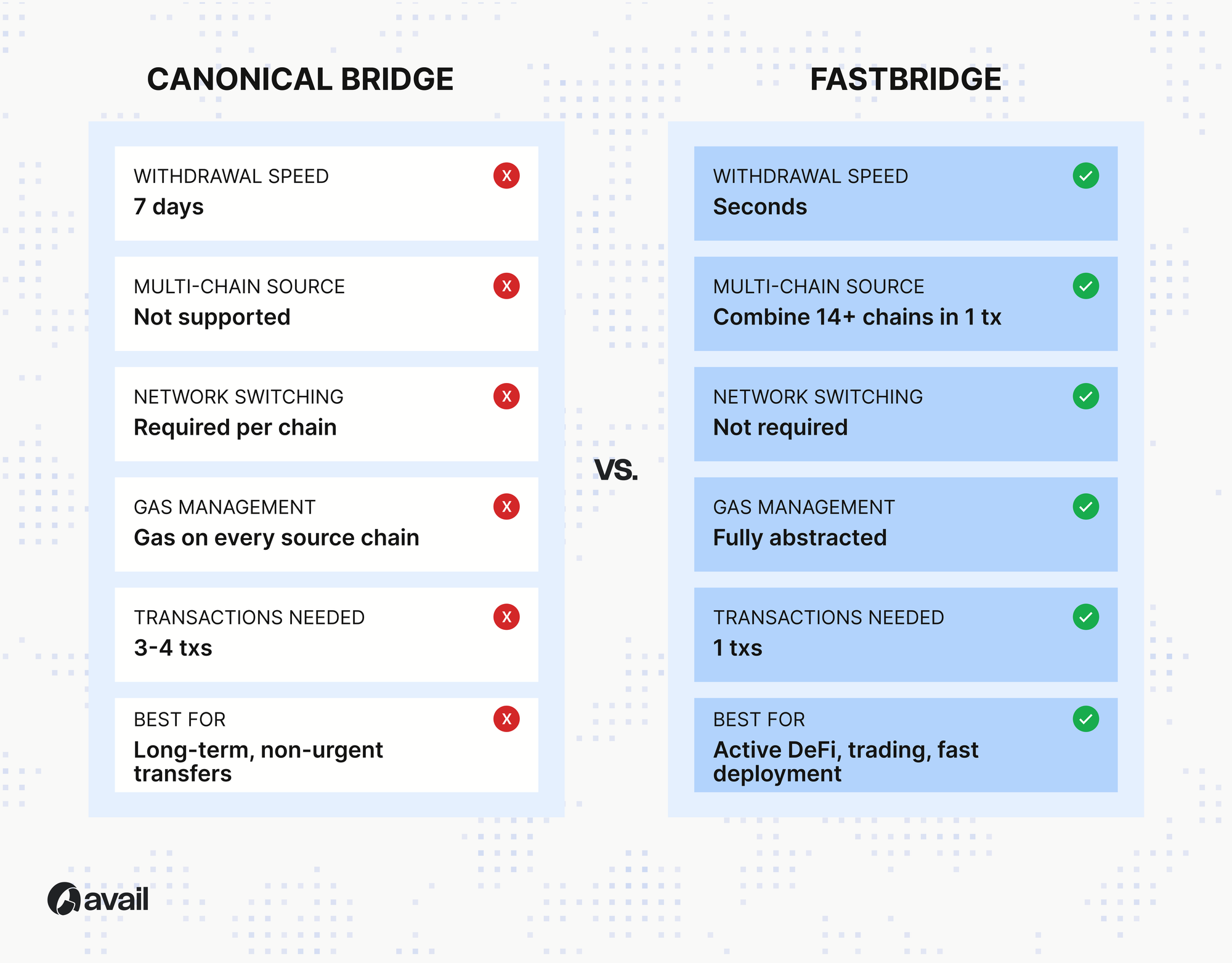
The key distinction is this: canonical bridges are optimised for trustlessness. FastBridge is optimised for usability and speed. For DeFi users who need to move crypto quickly across chains, these are not comparable tools, FastBridge is simply the right one for the job.
Side Note: Other Types of Bridges Worth Knowing
Here's a quick overview of other bridge types you'll encounter:
⬡ Lock-and-Mint Bridges
These bridges lock your asset on the source chain and mint a synthetic or wrapped version on the destination chain (e.g., WBTC). They're flexible but introduce wrapped asset risk – you're holding a representation of the original asset, not the asset itself. Redemption back to the original requires another bridge transaction.
⬡ Intent-Based Bridges
FastBridge is built on an intent architecture (Avail Nexus), which is an emerging paradigm in cross-chain bridging. Instead of executing a specific route, the user expresses intent and a solver network finds the optimal execution path. This enables better pricing, speed, and flexibility, including multi-source inputs and swaps, compared to fixed-route bridges.
So, what is an intent-based bridge?
An intent-based bridge is a bridge where you state the outcome you want, rather than the specific route to get there, and a solver network figures out the execution path for you. The user expresses an intent like "I want 500 USDT on Base," and the solver finds the fastest, most efficient way to fulfil it. This is the architecture FastBridge is built on via Avail Nexus, which is what makes multi-source bridging and swaps possible in a single transaction, something route-based bridges aren't designed to do.
⬡ Aggregator Bridges
Aggregator bridges (like Li.Fi or Socket) don't move assets directly, they route your transfer through the best available bridge at any given moment. Good for discovery and price optimisation, but they're only as fast as the underlying bridge they route through. They also typically handle one source chain at a time.
⬡ ZK-Verified Bridges
An emerging category using zero-knowledge proofs to verify cross-chain state without a challenge period. Faster than optimistic bridges in theory, but still maturing. Proof generation times and infrastructure complexity remain barriers to widespread adoption for end users.
The Verdict: Speed Wins for Active DeFi Users
Canonical bridges are trustless infrastructure, and that matters. But for anyone actively managing crypto across chains, the 7-day withdrawal window is a dealbreaker that no amount of security reassurance can justify.
FastBridge offers what active DeFi users actually need: fast crypto transfers across all 12 supported chains, consolidation of fragmented balances in a single transaction, built-in swaps so you always land in the asset you actually need, and a user experience that doesn't require a calendar to plan around.
Fast chains deserve fast bridges. FastBridge is built for the chains DeFi is moving to.