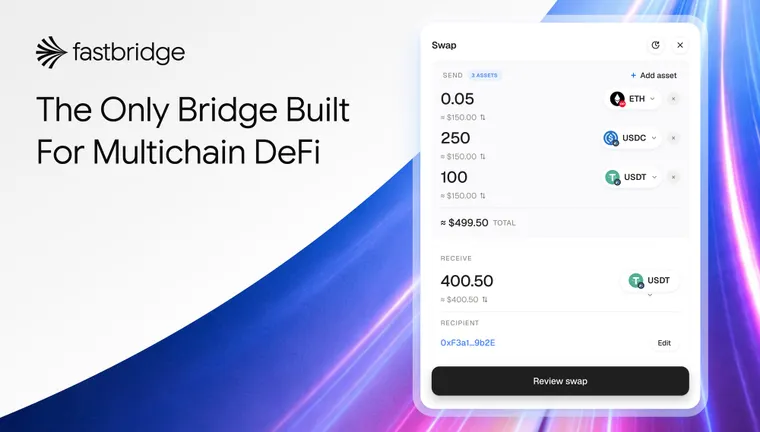




If you've been in DeFi for a while now, your funds are everywhere. Some USDC on Ethereum, a bit more on Arbitrum from a position you exited last week, a stack on Base from a yield farm, leftover USDT on Optimism. No single chain has everything you need, and every time a new protocol launches or a yield opportunity opens, you're back to the same manual process: figure out which chain has enough, switch networks, bridge, pay gas, wait for confirmation, and repeat as needed.
Most bridges were built to solve a single problem: move an asset from Chain A to Chain B. In a world where active DeFi users and traders operate across 5, 6, or 7 chains simultaneously, that's not a solution.
FastBridge was built for how DeFi actually works today. It reads your balances across all your chains at once, lets you combine them into a single bridge transaction, and delivers them to any destination chain in seconds, regardless of how many source chains your funds are sitting on.
The Fastest Way To Move Across Multiple Chains.
The Real Problem With Bridging in 2026
The multi-chain reality of DeFi isn't going away. If anything, it's getting more fragmented. Every new high-performance chain – MegaETH, Monad, Citrea, and the next wave after them – adds another place where your capital could be deployed, and another chain you need to bridge to when the opportunity is right.
The conventional bridging workflow hasn't kept up. Here's what it actually looks like when you want to move $1,000 of stablecoins to a new chain from your existing positions:
- Identify on which chains you have enough USDC/USDT to cover the amount
- Switch your wallet to Chain 1 and make sure you have gas
- Bridge and wait for confirmation
- Switch to Chain 2 and check you have gas there too
- Execute another bridge transaction, wait again
- Repeat for every other source chain
- Finally arrive on the destination chain with multiple native gas fees paid
That's not bridging. That's a workflow. And for users who do this regularly because they're chasing yield, rotating into new ecosystems, rebalancing across protocols, it adds up to a significant hidden cost in time, gas, and missed windows.
The gap isn't just about convenience, it's about whether users complete the process at all. Every additional step is a point where users can give up, not because they don't want to bridge, but because the experience is too cumbersome to complete. FastBridge removes those drop-off points entirely.
How to consolidate crypto from multiple chains into one wallet
The fastest way to consolidate crypto from multiple chains into one wallet is to use a multi-source bridge instead of bridging one chain at a time. FastBridge reads your balances across every connected chain at once, lets you specify how much to pull from each source, and delivers it all to a single destination in one signed transaction.
What Makes FastBridge Different
So what is FastBridge, and how does it work?
FastBridge is a unified cross-chain bridge powered by Avail Nexus; an intent-based coordination layer that abstracts the complexity of multi-chain routing into a single user action.
The feature that separates FastBridge from every other bridge on the market is multi-source input: the ability to combine your balances from multiple chains into a single bridge transaction, delivered to any supported destination chain in seconds.
Instead of bridging chain by chain, you specify how much to move from each source chain, then pick where it should land. FastBridge handles the routing.
How to bridge crypto from multiple chains in one transaction
To bridge crypto from multiple chains in one transaction, you need a bridge that supports multi-source consolidation rather than single-route transfers. With FastBridge, you add the specific amounts you want to bridge from each source chain and token, then pick the destination token and chain you want them delivered to. You review and sign once ; that single signature triggers routing across all selected source chains behind the scenes, and your funds land on the destination chain already consolidated, without you touching a separate transaction per chain.
How FastBridge works in short
- FastBridge reads your tokens across all supported chains simultaneously. You see your full cross-chain position in one view
- You add the amounts you want to bridge from each source chain and token
- You pick the destination token and chain you want it all delivered to
- You can adjust or deselect individual source chains at any point (FastBridge recalculates in real time)
- You review the swap or bridge and FastBridge routes across all selected source chains behind the scenes
- Your funds land on the destination chain in seconds, consolidated and ready to use
Here's a comparison of manually bridging from 3 source chains vs bridging from 3 source chains with FastBridge:
Example: I have assets on Arbitrum and Polygon - how do I combine them on Base?
With FastBridge, you don't bridge from Arbitrum and Polygon separately. Connect your wallet, enter the amounts you want to bridge from your Arbitrum and Polygon balances, then select Base as your destination chain and the token you want to receive. You sign once, and your consolidated balance lands on Base, no manual network switching, no separate bridge transaction for each source chain, and no need to hold gas on Arbitrum or Polygon since fees can be paid in stablecoins.
Key Differentiators:
- See all your balances in one place: Most bridges show you what you have on the chain your wallet is currently connected to. FastBridge shows your balances across every connected chain, no network switching required.
- Gas abstraction: No need to hold native tokens on every source chain. With FastBridge, you can pay fees in stablecoins (USDC/USDT).
- Choose your source chains: See exactly which chains and balances will be used and how much will be drawn from each. Deselect any you want to keep. FastBridge recalculates instantly, giving you both control and efficiency.
What used to take 3–4 bridge transactions, now takes just 1 with FastBridge.
Who FastBridge Is Built For
Yield chasers and liquidity rotators: If you actively track APYs and move capital as opportunities shift, speed impacts your returns. FastBridge gets you positioned in seconds, from any combination of chains your funds sit on.
New ecosystem explorers: New chains attract early liquidity, incentives, and strong first-mover advantages. FastBridge turns onboarding into a single action, removing the friction between spotting an opportunity and actually entering it.
Active multi-chain DeFi users: If your portfolio is spread across 5+ chains, bridging becomes a constant drain on time and capital. FastBridge consolidates fragmented balances across chains and moves them in one go, without manual coordination.
Anyone who has abandoned a bridge mid-process: Running out of gas or dealing with multi-step flows are the two most common reasons users drop off. FastBridge removes both, with gas abstraction and single-transaction execution, so you actually complete the action.
Multi-Chain DeFi Deserves a Multi-Chain Bridge
The way DeFi users actually operate, with capital spread across multiple chains, constantly rotating toward the best yield, always needing to be somewhere new quickly, has outgrown the one-to-one bridge model that most tools were built around.
FastBridge is the only bridge built for the reality of multi-chain DeFi. See all your balances at once. Pull from any combination of chains. Sign once. Arrive ready to trade.