





MegaETH is one of the most renowned new chains in the Ethereum ecosystem, built for real-time, high-frequency applications with millisecond block times and 100,000+ TPS. Developers are deploying on MegaETH to take advantage of its real-time execution stack, and traders are showing up to explore the unique use cases only a chain this fast makes possible.
There's just one problem: If your USDC is scattered across chains such as Ethereum, Arbitrum, and Avalanche, you're looking at 3 separate bridge transactions, network switches, multiple gas fees, and 10–20+ minutes of waiting, just to get liquid on MegaETH.
There's a more convenient way. FastBridge lets you combine balances from multiple chains in a single transaction and arrive on MegaETH ready to trade. No switching networks. No managing gas. No waiting.
This guide walks you through exactly how to bridge to MegaETH the fastest way in 2026.
— FastBridge by Avail
The Problem with Traditional Bridges
Standard bridges solve one problem: moving an asset from Chain A to Chain B. But in 2026, most users’ liquidity doesn't live on just one chain. It's fragmented; $200 on Ethereum, $150 on Avalanche, $300 on Arbitrum. And MegaETH is Chain D.
With a conventional multi-chain bridge tool, here's what bridging to MegaETH actually looks like:
- Switch to Ethereum → bridge $200 USDC to MegaETH → wait for confirmation
- Switch to Avalanche → bridge $150 USDC to MegaETH → wait for confirmation
- Switch to Arbitrum → bridge $300 USDC to MegaETH → wait for confirmation
That's three separate transactions, three network switches, three sets of gas fees, and potentially 20+ minutes of waiting. For anyone serious about DeFi, this is insufferable friction. The chains got fast. The bridges didn't.
How FastBridge Works
FastBridge is a unified stablecoin bridge, powered by Avail Nexus, an intent-based coordination layer that abstracts away all the complexity of moving stablecoins across multiple chains.
The core innovation is multi-source input. Instead of bridging chain by chain, FastBridge aggregates your stablecoin balances across all connected chains and lets you move them in a single transaction.
What this means in practice:
- FastBridge reads your USDC, USDT, USDM and ETH across all connected chains simultaneously
- You select your destination chain (e.g., MegaETH) and the total amount you want to arrive with
- FastBridge routes the optimal combination of your existing balances into a single cross-chain bridge transaction
- You sign once. FastBridge handles the rest.
No switching networks. No managing gas across 4 different chains. No timing 3 separate bridge windows. You specify what you want, and FastBridge delivers it.
Supported chains for cross-chain bridging:
FastBridge currently supports stablecoin transfers across major chains, including Ethereum, Arbitrum, Optimism, Base, Polygon, Avalanche, MegaETH, Monad, Citrea, HyperEVM, Kaia, Scroll and BNB. Bridge USDC, USDT, USDM, and ETH across all of them, in seconds.
How to Bridge to MegaETH Using FastBridge: Step-by-Step
Getting your stablecoins onto MegaETH with FastBridge takes under 60 seconds. Here's exactly how:
Step 1: Go to FastBridge
Head to fastbridge.availproject.org. FastBridge works directly in your browser, no downloads, no separate app required. Connect your wallet (MetaMask, Rainbow, Coinbase Wallet, or any WalletConnect-compatible wallet).
Step 2: Select MegaETH as your destination
In the destination chain selector, choose MegaETH. FastBridge immediately scans your wallet and shows your stablecoin balances across all connected chains (e.g. Ethereum, Arbitrum, Avalanche).
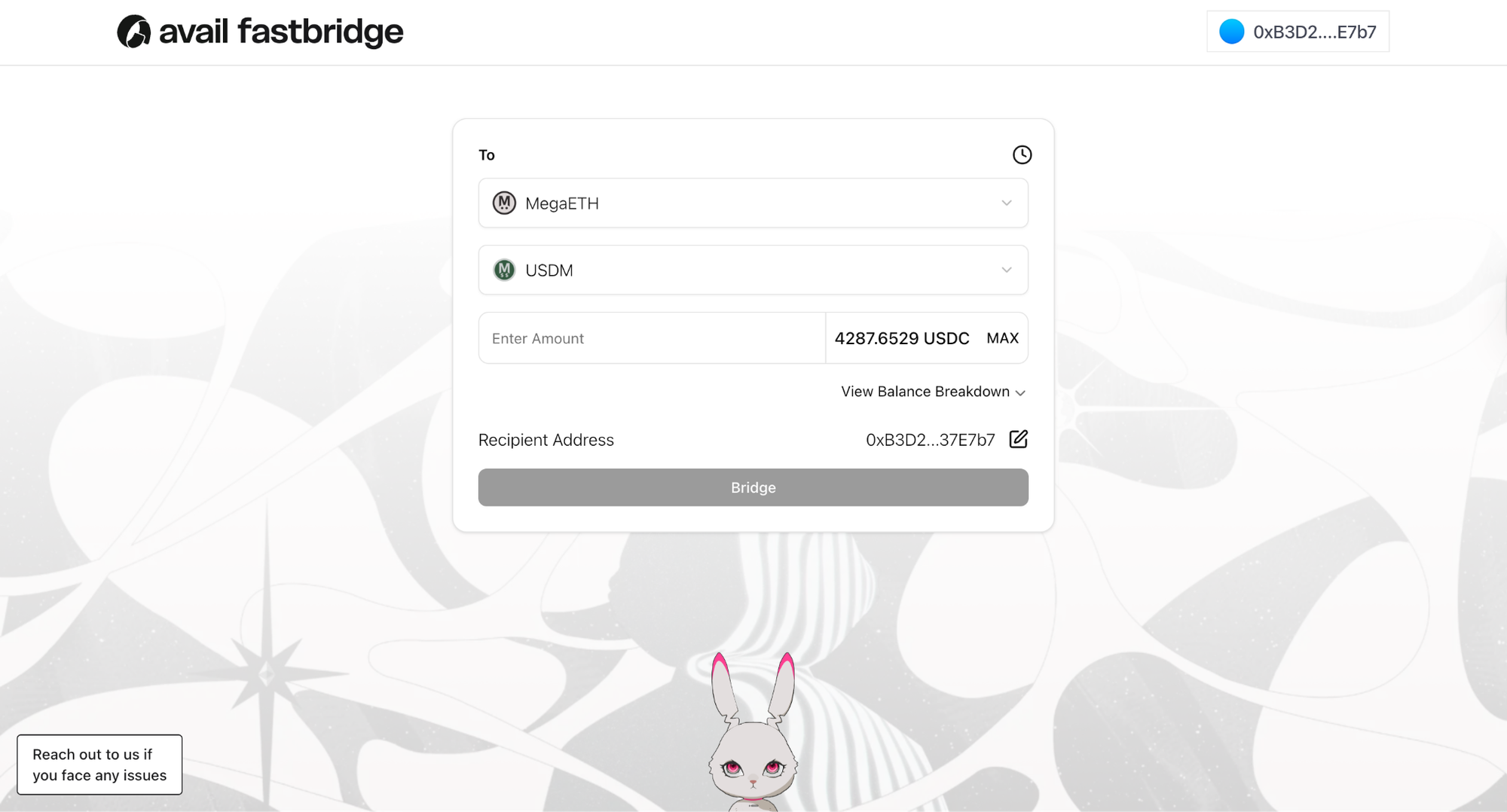
Step 3: Enter the amount you want to arrive with
Input the total USDC or USDT amount you want on MegaETH. FastBridge automatically identifies the optimal combination of your multi-chain balances to fulfill the request.Want more control over where the funds come from? You can manually deselect any source chain directly from the balance breakdown. FastBridge will recalculate and route only from the chains you've selected, useful if you want to preserve a balance on a specific network or prefer to draw from certain chains first.
Step 4: Review and sign once
FastBridge shows you a clear summary: source chains, amounts, and estimated fees. No hidden costs. You sign a single transaction. The multi-chain bridging happens behind the scenes via Avail Nexus.
Step 5: Arrive on MegaETH, ready to transact
Within seconds, your stablecoins land on MegaETH. No additional steps. Ready to interact with DeFi protocols, liquidity pools, or any MegaETH dApp immediately.
Why Fast Crypto Bridging Matters in a Real-Time Chain
Slow bridging is architecturally incompatible with what MegaETH is trying to achieve. If you have to wait 20 minutes to get your stablecoins onto MegaETH, you're not experiencing the chain the way it was designed to run.
FastBridge was built for exactly this environment. It's the native bridging experience for MegaETH, optimised for speed and built for users who need to arrive ready.Whether you're a DeFi user looking to deploy liquidity, a trader positioning ahead of a new protocol launch, or a developer testing cross-chain flows, FastBridge gets you there.