
Your users hold assets across Ethereum, Arbitrum, Optimism, Base, Polygon, and a dozen other networks. When they want to do something simple, like deposit into a vault on your app, they’re faced with too many decisions. Find a bridge, approve a transaction, wait for confirmation, switch networks in their wallet, approve again, and finally deposit. That's six or more steps for what should be one click.
Chain abstraction is the infrastructure pattern that makes all of this disappear. It removes the need for users to know, choose, or interact with specific blockchains. Routing, bridging, gas payments, and settlement all happen in the background. The user sees one balance, clicks one button, and deposits into your app.
Think of it like TCP/IP. When you load a webpage, you don't choose which physical network carries your packets or which DNS resolver handles your query. The Internet Protocol stack handles that complexity behind a simple interface. Chain abstraction does the same thing for blockchains, turning a mess of disconnected networks into a single, usable onchain economy.
The demand is clearly there. Cross-chain bridge volumes have periodically reached tens of billions of dollars per month during peak cycles, and stablecoin transaction volumes alone hit $33 trillion in 2025, according to data compiled by Artemis Analytics. Users are constantly moving assets between chains. The tooling just hasn't caught up to make it seamless.
This guide breaks down how chain abstraction works, why it matters most at the deposit layer, and how to actually integrate it into your app. By the end, you'll understand the full stack, know how to evaluate solutions, and have a clear path to adding cross-chain deposits with a single SDK integration.
Why Chain Fragmentation Is Costing Your App Users
The multichain world was supposed to be a feature. More chains meant more throughput, lower fees, and specialized environments for different use cases. And on the infrastructure side, that's largely delivered. The problem is that nobody solved the user experience.
Liquidity is scattered across chains and protocols. A user might hold USDC across five different chains, some on Ethereum mainnet from an older position, some on Arbitrum from a recent swap, a bit on Base from a friend's payment, and so on. No single chain holds their full balance. When your app needs a deposit, that fragmentation becomes your app’s problem.
The typical flow for a user who has funds on the wrong chain looks something like this: they realize their assets aren't on the right network, leave your app to find a bridge, connect their wallet to the bridge, approve the token spend, execute the bridge transaction, wait for confirmation, switch their wallet to the destination network, return to your app, connect again, approve the token for your contract, and finally deposit. That's at least a 10-to-12-click process where every click is a drop-off point.
This is the crypto equivalent of cart abandonment, and it's happening at scale. If you've ever looked at your funnel analytics and seen a cliff between "wallet connected" and "deposit completed," fragmentation is almost certainly a contributor.
It's painful for developers too. Supporting multiple chains means maintaining deployments, managing liquidity pools, handling gas, and building a UI for network switching, all per chain. Every new chain you add multiplies your maintenance surface. That's engineering time spent on plumbing instead of product enhancements.
What Is Chain Abstraction?
Chain abstraction is an infrastructure pattern that removes the need for users or developers to know, choose, or interact with specific blockchains. It handles network selection, asset routing, gas payments, and settlement in the background, creating a single unified experience across chains.
Instead of asking "which chain are your funds on?" and building different logic for each answer, a chain-abstracted app simply asks "what do you want to do?" and handles the rest.
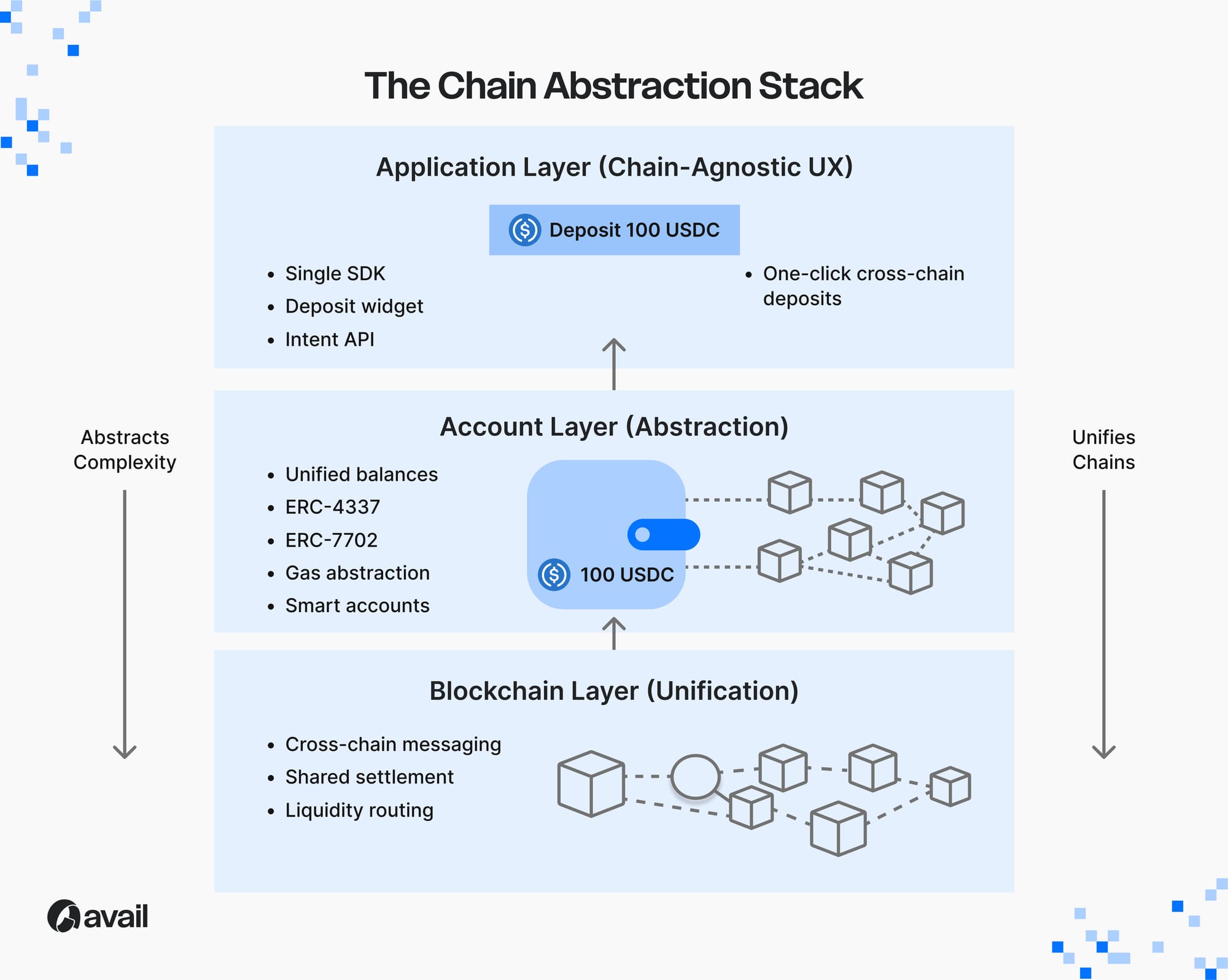
The chain abstraction stack has three layers, each solving a different part of the problem.
The blockchain layer (unification) is about making chains interoperable at the protocol level. This includes shared settlement mechanisms, cross-chain messaging protocols, and proposed standards like ERC-7683 (the cross-chain intents standard co-developed by Uniswap Labs and Across Protocol), which defines a common format for expressing cross-chain actions so that different systems can share infrastructure and filler networks. Unification is what makes it technically possible for value to move between chains in a trust-minimized way.
The account layer (abstraction) gives users a single identity and unified balances across chains. Instead of seeing separate balances on each network, the user sees one aggregated view. This layer typically leverages account abstraction (ERC-4337) to enable features like gasless transactions, social recovery, and session keys, but extends it across chains rather than on a single network.
The application layer (chain-agnostic developer experience) is where it all comes together for builders. A single SDK or API integration gives your app cross-chain capabilities without per-chain deployment logic. You write one integration, and it works across all supported chains. This is the layer where cross-chain SDKs, deposit widgets, and intent-based transaction APIs live.
Three related concepts come up frequently in these conversations, and it's worth drawing clear lines between them.
Chain abstraction vs. account abstraction: Account abstraction (ERC-4337) upgrades wallet functionality on a single chain. It enables features like gas sponsorship, batched transactions, and social recovery. Chain abstraction is broader. It removes the need to know which blockchain you're interacting with entirely. Account abstraction is often a component within a chain abstraction stack, but it doesn't solve the cross-chain problem on its own.
Chain abstraction vs. gas abstraction: Gas abstraction is one specific feature within the larger chain abstraction stack. It means users don't need to hold native gas tokens (ETH on Ethereum, MATIC on Polygon, etc.) to transact. Fees are deducted from the transaction asset itself or sponsored entirely. Useful on its own, but it only addresses one piece of the fragmentation puzzle.
Chain abstraction vs. bridging: Traditional bridges require users to manually move assets between chains in a separate step. Chain abstraction removes that step entirely while bridging still happens under the hood, but it's invisible to the user and handled automatically as part of the transaction flow.
How Chain Abstraction Works in Practice
Concepts are useful, but a concrete example makes the architecture click. Here's what chain abstraction looks like from both the user's perspective and under the hood.
Alice's deposit: Alice holds 100 USDC spread across five chains, 20 each on Ethereum, Arbitrum, Optimism, Base, and Polygon. She opens a DeFi lending app deployed on Base and wants to deposit all 100 USDC into a yield vault.
In a chain-abstracted app, Alice connects her wallet and sees a unified balance: 100 USDC. She doesn't see five separate balances on five separate networks. She clicks "Deposit 100 USDC," confirms one transaction, and her deposit is complete. She never switches networks, never approves a bridge, never worries about gas on four different chains.
Here's what happened behind the scenes, broken down into four stages.
Step 1: Intent signaling When Alice clicks "Deposit," the app doesn't send a traditional transaction. Instead, it broadcasts an intent: "Alice wants to deposit 100 USDC into vault X on Base." This intent contains all the information needed to fulfill the request (the source assets, destination chain, target contract, and acceptable execution parameters) but doesn't prescribe how to get it done.
Step 2: Solver auction The intent enters a competitive marketplace of solvers (also called fillers or relayers). These are specialized actors who compete to fulfill cross-chain intents at the best combination of speed, cost, and execution quality. Multiple solvers evaluate Alice's intent and bid to fulfill it. The auction can happen in milliseconds.
Step 3: Execution The winning solver handles everything: aggregating Alice's USDC across the five source chains, bridging assets to Base, handling gas payments on each chain, and routing through the most capital-efficient path. Alice doesn't see any of this. If one route is congested or expensive, the solver finds an alternative. The solver's economic incentive, they profit from the spread between execution cost and the quoted price, ensures Alice gets competitive pricing.
Step 4: Settlement The 100 USDC arrives on Base and is deposited directly into the vault contract. The solver is reimbursed through the settlement layer. Alice sees a single confirmation in her wallet.
What this means for developers: from your perspective as the app builder, the entire flow above is handled by a cross-chain SDK. You don't build bridge integrations. You don't write per-chain gas logic. You don't run solver infrastructure or optimize routing. You integrate one SDK, configure the deposit parameters, and the chain abstraction layer handles everything else. Your app works on every supported chain from day one.
Chain Abstraction for Deposits: Why It Matters Most for App Builders
If you build a DeFi app such as a lending protocol, a yield vault, a perpetual exchange, or a staking platform, the deposit feature is your front door. It's the very first on-chain action a user takes, and it's where chain fragmentation hits hardest.
The math is straightforward. Your user has money. They want to put it in your app. The only thing stopping them is that their assets are on a different chain than your contract. This isn't a user acquisition problem because you've already won the user's attention. It's a pure infrastructure problem, and it's the single highest-leverage point to solve.
Cross-chain deposit infrastructure eliminates this friction by accepting any token from any supported chain and converting it into the target token on the target chain, in a single user action. The user picks a token and an amount, the system handles bridging, swapping, and gas, and your smart contract receives the deposit.
This is where Avail Deposits enters the picture. Built on Avail Nexus, the unification layer that connects every major EVM ecosystem, Avail Deposits gives app builders a single SDK integration for accepting cross-chain deposits. The architecture is built on the intent-based execution and solver network model described above, with a few specifics worth noting:
- 15+ chain coverage: across all major EVM networks, including Ethereum, Arbitrum, Optimism, Base, Polygon, Monad, MegaETH, Citrea, and more.
- Any-token-in: users can deposit from whatever token they hold, with automatic swapping and bridging handled by the solver network.
- Full gas abstraction: users never need native gas tokens on the source chain.
- Non-custodial and audited: funds flow through smart contracts, not centralized relayers.
- 1-line widget integration: for the simplest path, or a full SDK for custom UIs.
That's the minimum viable integration. The widget handles wallet connection, balance aggregation, chain detection, route optimization, and transaction execution. For developers who want deeper control, the Nexus SDK documentation covers the full feature set, including programmatic deposit flows, webhook callbacks, and custom UI integration.
For a deeper look at how the cross-chain swap mechanics work under the hood, the Avail blog covers it in detail.
Evaluating Chain Abstraction Solutions
Not all chain abstraction implementations are equal. If you're choosing infrastructure for cross-chain deposits or any cross-chain functionality, here's a framework for evaluating your options.
Chain coverage: How many chains does the solution support, and how quickly do they add new ones? Some solutions only cover 2–3 major chains, which limits your addressable user base. Others support 15+ EVM-compatible networks, which means you can accept deposits from users regardless of where their assets sit. Ask whether the solution also has a roadmap for non-EVM chains if that matters for your app.
Integration effort: Does the solution offer a single SDK or API that works across all supported chains, or does it require you to deploy contracts and configure infrastructure per chain? The difference between a one-line widget embed and weeks of per-chain integration work is significant. Evaluate both the happy path (how fast can you ship a basic integration) and the advanced path (how much control do you have for custom flows).
Gas fees handling: Does the solution fully abstract gas, meaning users never need native tokens on any chain? Or do users still need to hold ETH, or other gas tokens to initiate transactions? Full gas abstraction is table stakes for a good user experience. If users need to acquire a gas token before they can deposit, you've reintroduced one of the core friction points that chain abstraction is supposed to eliminate.
Security model: Is the system non-custodial? Are the smart contracts audited? Does settlement rely on decentralized verification or centralized relayers? The security model directly affects the trust assumptions your users inherit. Non-custodial, audit-verified systems with decentralized solver networks offer the strongest guarantees.
Deposit support: Can the solution accept any token on any chain and convert it to the target token your contract expects? Or is it limited to specific token pairs? Broad token support, sometimes called "any-token-in," dramatically increases the pool of users who can deposit without additional steps.
Settlement speed and reliability: How long does an average cross-chain deposit take from intent to completion? What's the failure rate? Competitive solver auctions tend to optimize for both speed and reliability, since solvers have economic incentives to execute quickly and correctly.
Getting Started with Chain Abstraction on Avail
If you're ready to add cross-chain deposits to your app, here's the practical path from zero to production.
Step 1: Explore the product.
Start with the Avail Deposits landing page to understand the supported chains, tokens, and integration options. Review the use cases and see how other apps have implemented cross-chain deposits.
Step 2: Read the SDK documentation.
The Nexus SDK quickstart guide walks through the integration architecture, authentication setup, and configuration options. This is where you'll decide between the drop-in widget (fastest path) and the programmatic SDK (maximum control).
Step 3: Integrate.
For the widget approach, add the component to your frontend. For custom integrations, use the SDK's deposit to build the flow into your existing UI. Either way, you're looking at hours of integration work, not weeks.
Step 4: Test on testnet.
Deploy your integration to a supported testnet and verify end-to-end deposit flows. Test with multiple source chains and token types to confirm routing and settlement work as expected.
Step 5: Ship and get support.
Push to production and monitor deposit flows through the SDK's analytics. If you need custom integration support, white-glove onboarding, or want to discuss specific architectural requirements, schedule a discovery call with the Avail team.
The whole process, from reading the docs to accepting your first cross-chain deposit in production, is designed to take days, not weeks.
Frequently Asked Questions
What is chain abstraction?
Chain abstraction removes the need for users to choose or understand different blockchains by handling all network interactions in the background. It creates a unified experience where users can perform actions (deposits, swaps, payments) without switching networks, managing multiple wallets, or holding various gas tokens. The complexity of routing, bridging, and settlement is fully invisible to the end user.
What is the difference between chain abstraction and account abstraction?
Account abstraction (ERC-4337) upgrades wallet functionality on a single chain with features like gas sponsorship, batched transactions, and social recovery. Chain abstraction is broader; it removes the need to know which blockchain you're interacting with entirely. Chain abstraction often uses account abstraction as one component within its stack, but account abstraction alone doesn't solve cross-chain fragmentation.
How does chain abstraction help developers?
Developers can build apps that work across multiple chains without creating separate deployments or integration logic for each network. A single SDK integration handles cross-chain routing, gas abstraction, and settlement. This reduces development time from weeks to hours and eliminates the ongoing maintenance burden of supporting each chain individually.
What is a cross-chain swap?
A cross-chain swap exchanges tokens between different blockchains in a single user-facing transaction. Instead of manually bridging assets to the destination chain and then swapping to the desired token in separate steps, chain-abstracted solutions route the entire flow automatically through solver networks. The user only sees the end result: the token they wanted, on the chain they wanted it.
How do I add cross-chain deposits to my app?
Integrate a cross-chain deposit SDK like Avail Nexus. With a single widget embed or API integration, your app can accept deposits from any token on all major EVM chains, with bridging, swapping, and gas handled automatically in the background. The Nexus SDK quickstart guide covers the full integration process.