




Accepting crypto payments is no longer a novelty feature; it's a growth lever. Stablecoin transaction volumes reached $33 trillion in 2025, regulatory frameworks like the GENIUS Act are providing legal clarity in the US, and consumer wallets are more active than ever. If your app or business doesn't accept crypto, you're leaving money on the table.
Today, the landscape has changed. The first generation of cryptocurrency payment gateways was built for a single-chain world: accept Bitcoin, convert to dollars, settle to a bank account. That model still works for traditional e-commerce. But in 2026, with over a thousand active blockchains and users holding assets across dozens of networks, the payment problem has evolved. Users need to pay from whichever chain their assets are on, and the best payment infrastructure handles that automatically.
This guide reviews the top cryptocurrency payment gateways available today, from enterprise stalwarts like BitPay to open-source options like BTCPay Server to cross-chain deposit infrastructure like Avail Deposits. Whether you're building a Shopify store, a SaaS product, or a DeFi protocol, you'll find the right fit for your use case.
What Is a Cryptocurrency Payment Gateway?
A cryptocurrency payment gateway is a software that enables businesses and applications to accept payments in digital assets. It sits between the payer's wallet and the recipient, handling transaction detection, confirmation, and settlement; similar to how Stripe or PayPal processes fiat card payments, but using blockchain rails instead.
The basic flow works like this: a customer initiates a payment, the gateway generates a payment address or invoice, the customer sends crypto from their wallet, the gateway monitors the blockchain for confirmation, and once confirmed, the funds are settled to the merchant (either as crypto or converted to fiat currency).
There's an important distinction between a payment gateway and a payment processor. The gateway is the interface and API layer that handles the checkout experience, generates invoices, and communicates with your app. The processor handles the backend settlement: converting crypto to fiat, managing liquidity, and depositing funds into bank accounts. Some providers bundle both (e.g., BitPay, CoinGate), while others focus on a single layer.
In 2026, two distinct models have emerged. Traditional gateways like BitPay and Coinbase Commerce that focus on merchant checkout, accept crypto, convert to fiat, and settle to a bank. They are built for e-commerce, invoicing, and point-of-sale. Cross-chain deposit solutions like Avail Deposits solve a different problem: accepting deposits from any token on any blockchain, with automatic bridging and swapping. These are built for DeFi apps, on-chain protocols, and crypto-native platforms where the "payment" is a deposit into a smart contract, not a merchant checkout.
Understanding which model fits your use case is the first step toward choosing the right infrastructure.
How to Choose the Right Crypto Payment Gateway
Before diving into specific providers, here's the framework for evaluating any cryptocurrency payment gateway. Every business has different priorities, but these six criteria cover the essentials.
Supported cryptocurrencies and chains. The minimum viable coverage is Bitcoin and Ethereum. But if your users hold stablecoins on Layer 2 networks like Arbitrum or Base (and increasingly, they do), you need a gateway that supports those chains natively. Some gateways support 200+ tokens, but only on a handful of chains. The key is to match the coverage to where your users actually hold their assets.
Fee structure. Most gateways charge between 0.5% and 2% per transaction. But watch for additional costs: fiat conversion fees, withdrawal fees, monthly subscription charges, and minimum payout thresholds. Some gateways (BTCPay Server) charge nothing because they're self-hosted. Others (Avail Deposits) charge no platform fee, passing only transparent on-chain gas costs to users. Calculate the true all-in cost, not just the headline rate.
Integration complexity. If you're running a Shopify or WooCommerce store, you want a pre-built plugin that installs in minutes. If you're building a custom app, you need a well-documented API or SDK. The range spans from zero-code plugins to full programmatic SDKs with webhook callbacks and custom UI components. Consider how much control you need and how much engineering time you're willing to invest.
Fiat conversion and settlement speed. Do you need funds in dollars, euros, or pounds? Traditional gateways offer automatic fiat conversion with daily or next-day bank settlement. If you're building a crypto-native app and want on-chain settlement, fiat conversion may be irrelevant. Know which model you need before you evaluate.
Security, compliance, and audits. Custodial gateways hold funds on your behalf, make sure they're licensed and insured. Non-custodial solutions give you full control but shift the security responsibility to you. Check for smart contract audits, KYC/AML compliance tooling, and PCI compliance for any fiat-touching components.
Cross-chain support and bridging. This is the criterion that separates 2026-era payment infrastructure from the previous generation. Traditional gateways assume the user is already on the right chain with the right token. Cross-chain solutions handle bridging and swapping automatically; the user pays from wherever their assets are, and the gateway delivers the correct token on the correct chain to your contract. For DeFi apps, this is the single most impactful feature.
Best Cryptocurrency Payment Gateways in 2026
1. BitPay
BitPay is the longest-running crypto payment processor, founded in 2011 and used by enterprise merchants like Microsoft, AMC, and Newegg. It's the gateway most comparable to traditional payment infrastructure, designed to make crypto feel like credit cards for the merchant.
Best for: Enterprise businesses and established merchants wanting fiat settlement, compliance tooling, and institutional-grade infrastructure.
Key features: Direct bank settlement in USD, EUR, GBP, and other currencies. Invoicing and billing tools with subscription support. Dedicated POS app for retail. White-label checkout. Integration with QuickBooks for accounting. PCI-compliant with full KYC/AML tooling.
Limitations: Limited altcoin support compared to newer competitors. Requires full KYC for all merchants. Not designed for DeFi or on-chain deposit use cases. No cross-chain bridging capabilities.
Fees: 1% per transaction, with volume-based discounts available for large merchants.
Chains supported: Bitcoin, Ethereum, select ERC-20 tokens, and a small number of additional networks.
2. Coinbase Commerce / Coinbase Business
Coinbase Commerce has been the go-to for merchants who want the credibility of the Coinbase brand behind their checkout. In 2025–2026, Coinbase began unifying commerce with its broader Coinbase Business platform, adding custody and cash-out capabilities. The new Commerce Payments Protocol, built on Coinbase's Base L2, brings an authorize-and-capture model (similar to credit card flows) to on-chain payments.
Best for: Merchants and startups who want a trusted brand, straightforward API, and the option for either self-custodial or Coinbase-managed settlement.
Key features: Self-managed (non-custodial) and Coinbase-managed account options. Integration with Shopify and WooCommerce. Payment links for in-app and invoice-based flows. USDC rewards on balances. Commerce Payments Protocol on Base for sub-second settlement.
Limitations: Self-managed accounts don't offer direct fiat withdrawal; you need a Coinbase-managed plan for that. Chain coverage is limited (Ethereum, Polygon, Base, Bitcoin). Not built for multi-chain DeFi deposits.
Fees: 1% per transaction across both account types.
Chains supported: Ethereum, Polygon, Base, Bitcoin.
3. NOWPayments
NOWPayments is the choice for businesses that need to accept a long tail of cryptocurrencies. Built by the team behind ChangeNOW, it supports over 200 tokens with auto-conversion between them, making it a flexible option for SaaS platforms, digital marketplaces, and international services.
Best for: Businesses needing broad altcoin support, low fees, and flexible integration across e-commerce and custom platforms.
Key features: 200+ supported cryptocurrencies. Auto-conversion between tokens at the point of payment. Subscription and recurring billing support. Plugins for Shopify, WooCommerce, and other platforms. Mass payouts for affiliate and creator payments. Non-custodial model available. Recognized by Forbes as a top crypto payment service.
Limitations: No direct fiat settlement; requires a third-party partner (Guardarian) for fiat off-ramps. Less enterprise track record than BitPay. No cross-chain aggregation or bridging, each token is processed on its native chain only.
Fees: 0.5% per transaction on the standard plan, with custom pricing for higher volumes. No monthly fees on the base tier.
Chains supported: 200+ tokens across their native chains, though without cross-chain bridging between them.
4. CoinGate
CoinGate is a Europe-based gateway with strong e-commerce integrations and one of the early adopters of Bitcoin's Lightning Network for instant payments. It's a solid middle-ground option for small to mid-sized merchants who want a plugin-based setup with fast settlement.
Best for: E-commerce merchants wanting easy plugin-based integration with Lightning Network support for fast BTC payments.
Key features: Lightning Network support for near-instant Bitcoin settlements. 70+ cryptocurrencies accepted. Pre-built plugins for Shopify, WooCommerce, Magento, PrestaShop, and WHMCS. Fiat payouts in EUR and USD. Hosted payment page for quick setup without coding. Refund support.
Limitations: 1% transaction fee with payout minimums. Limited API customization for complex or DeFi-native flows. Not designed for cross-chain deposits or multi-chain routing.
Fees: 1% per transaction. Fiat conversion included in the fee. Payout minimums apply.
Chains supported: Bitcoin (including Lightning), Ethereum, Litecoin, and 70+ additional tokens on their native chains.
5. BTCPay Server
BTCPay Server is the open-source, self-hosted option for merchants and developers who want zero fees, zero third parties, and full sovereignty over their payment stack. There's no company holding your funds or taking a cut; you run the software on your own server and receive payments directly to your wallet.
Best for: Privacy-focused developers and businesses who want complete control, no KYC requirements, and no platform fees.
Key features: Entirely free and open-source. Self-hosted on your own infrastructure. No KYC requirements (you're the payment processor). Lightning Network support for instant Bitcoin payments. Plugin ecosystem with community contributions. Integrations for WooCommerce, Shopify (via workaround), Drupal, and custom APIs. Point-of-sale app for in-person payments.
Limitations: Requires technical setup; you need to provision and maintain a server. No fiat conversion or bank settlement (crypto-only by default). Limited to Bitcoin and a small number of altcoins without additional configuration. No cross-chain or multi-chain support out of the box.
Fees: None. Self-hosted means no transaction fees, no monthly fees, no platform fees. You pay only for your own server hosting.
Chains supported: Bitcoin (on-chain + Lightning) primarily. Altcoin support available through community plugins (Monero, Litecoin).
6. CoinsPaid
CoinsPaid is a B2B crypto payment processor handling high-volume transactions for iGaming, digital services, and large-scale e-commerce. It's a managed infrastructure solution for businesses processing significant volume, not a self-service developer tool.
Best for: High-volume businesses needing robust processing, instant fiat conversion, and dedicated compliance infrastructure.
Key features: Enterprise-grade uptime for high transaction volumes. 100+ supported cryptocurrencies. Instant fiat conversion with the OTC desk. Strong licensing and compliance tooling. White-label checkout. Dedicated account management.
Limitations: Requires B2B onboarding with likely minimum volume commitments. Less relevant for indie developers or DeFi protocols. Proprietary system with less flexibility than SDK-based solutions.
Fees: Custom pricing, negotiated per client based on volume and requirements.
Chains supported: 20+ blockchains with 100+ tokens.
7. Avail Deposits (Nexus SDK)
Avail Deposits is a fundamentally different kind of payment infrastructure. It's not a traditional merchant checkout gateway. It's a cross-chain deposit infrastructure built on Avail Nexus, designed for DeFi apps and crypto-native platforms that need to accept deposits from any token on any popular EVM chain.
Where traditional gateways convert crypto to fiat for merchants, Avail Deposits routes assets from any connected source chain to your target contract, handling bridging, swapping, and gas automatically. The user sees one balance, clicks once, and the deposit lands on your chain in the right token.
Best for: DeFi protocols, yield vaults, lending apps, perpetual exchanges, and any on-chain application where the "payment" is a smart contract deposit, not a merchant checkout.
Key features: All major EVM chains supported (Ethereum, Arbitrum, Optimism, Base, Polygon, and more, see the full list of supported networks here). Any-token-in: users deposit from whatever token they hold, with automatic cross-chain swapping and bridging. Full gas abstraction, as users never need native gas tokens on any chain. Non-custodial smart contract infrastructure, audited by Oak Security. Drop-in widget integration or full programmatic SDK. Intent-based execution with competitive solver routing for best pricing.
Multi-source deposits: exclusive to Avail Deposits. Avail is the only solution today that supports multi-source inputs. A user with ETH on Arbitrum and USDC on Polygon can fund a single LP position on a Base-based DEX in one flow; no manual bridging, no multiple transactions, no leaving your app. No other gateway or deposit solution handles this today.
Limitations: EVM-only at present; no SVM or non-EVM chain support yet. No fiat off-ramp (designed for on-chain settlement, not merchant fiat conversion). Not suited for traditional e-commerce checkout or invoicing flows.
Fees: No platform fee. Users pay transparent on-chain gas costs only.
Chains supported: EVM-compatible chains, see the full list of supported networks here.
For a deeper look at the cross-chain swap mechanics, see the technical walkthrough on Avail's blog. To learn more about the Nexus SDK, see the SDK overview.
Why Cross-Chain Matters: The Next Era of Crypto Payments
Every gateway reviewed above solves some version of the same problem: accepting crypto from a user and getting it to a merchant or contract. But there's a growing gap between what traditional gateways were designed for and what the multichain world demands.
The core issue is liquidity fragmentation. In 2026, user assets are spread across Ethereum, Arbitrum, Optimism, Base, Polygon, and many other networks. When someone wants to deposit into a DeFi vault or pay for a service on a specific chain, having their funds on a different chain creates real friction. Traditional gateways assume the user is already on the right network with the right token. In practice, they often aren't.
The result is user drop-off. A user opens your app, sees the deposit button, realizes their USDC is on Arbitrum while your contract lives on Base, and leaves to find a bridge (if they come back at all). Every additional step in that flow is a conversion killer. Manual bridging, gas token acquisition, and network switching are the invisible costs that don't show up in your gateway's fee schedule but destroy your funnel.
Traditional payment gateways weren't built for this. They were designed for a world where a user pays in BTC or ETH on a single chain, and the gateway converts it to fiat. That model still works well for e-commerce. But for DeFi protocols, on-chain platforms, and crypto-native apps where the destination is a smart contract, not a bank account, you need infrastructure that speaks the multichain language natively.
This is the problem Avail Deposits solves. Instead of requiring users to bridge first and deposit second, the entire flow is collapsed into a single action. The user's assets are aggregated across chains, routed through a competitive solver network, bridged and swapped automatically, and deposited directly into the target contract. No network switching, no gas token acquisition, no separate bridging step.
Apps like Clober, and Bean Exchange have adopted this approach to eliminate the deposit friction that was costing them users. The pattern is clear: as crypto becomes increasingly multichain, payment and deposit infrastructure needs to be cross-chain by default, not as an afterthought.
This doesn't mean traditional gateways are obsolete. If you're running an e-commerce store and need fiat settlement, BitPay or Coinbase Business is still the right call. But if you're building an on-chain app where deposits are the front door, cross-chain infrastructure is the new table stakes.
How to Integrate a Crypto Payment Gateway Into Your App
The integration path depends on your platform and use case. Here are the two most common approaches.
For traditional e-commerce (plugin or API):
Most merchant gateways offer pre-built plugins for popular platforms. On Shopify or WooCommerce, you can typically install a gateway plugin, configure your API keys and payout preferences, select which cryptocurrencies to accept, and start processing payments within an hour. For custom applications, the pattern is similar: register for an API key, use the gateway's REST API to generate payment invoices, listen for webhook callbacks to confirm payments, and handle settlement logic in your backend.
For DeFi and on-chain apps (Avail Nexus SDK):
If your app needs cross-chain deposits rather than merchant checkout, the Nexus SDK provides both a drop-in widget and programmatic elements. The SDK integration handles wallet connection, chain detection, balance aggregation, route optimization, and transaction execution. For developers who want full control over the UI, the SDK provides deposit flows, webhook callbacks, and custom integration patterns.
Integration is fast, most teams are live within hours, not weeks.
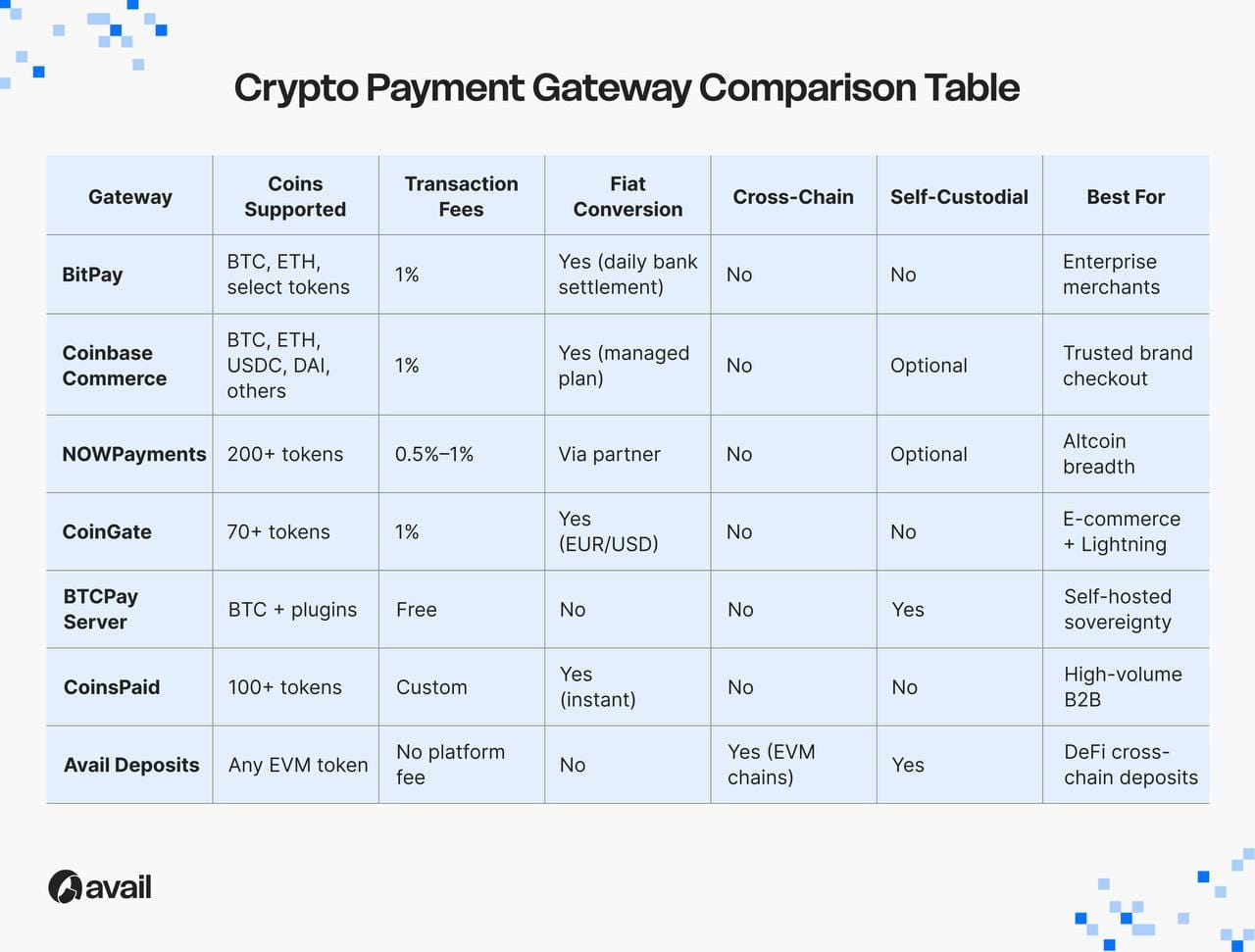
The key takeaway: traditional gateways and cross-chain deposit solutions serve different use cases. If you're building a merchant checkout that needs fiat settlement, the top half of this table is your starting point. If you're building an on-chain app where users deposit into smart contracts from any chain, Avail Deposits fills a gap that traditional gateways don't address.
Frequently Asked Questions
What is the best cryptocurrency payment gateway in 2026?
It depends on your use case. BitPay is the strongest option for enterprise merchants who need fiat bank settlement and compliance infrastructure. NOWPayments offers the broadest altcoin support with competitive fees. BTCPay Server is the best choice if you want zero fees and full self-hosting. For DeFi apps and on-chain platforms that need cross-chain deposits from any token on any chain, Avail Deposits is built specifically for that use case.
How do I accept crypto payments on my website?
Choose a payment gateway that fits your platform and use case. For e-commerce stores on Shopify or WooCommerce, install a plugin from CoinGate or NOWPayments; setup takes minutes. For custom applications, integrate via the gateway's API. For DeFi apps needing cross-chain deposit functionality, integrate the Avail Nexus SDK with a single widget embed or API call.
What fees do crypto payment gateways charge?
Most charge between 0.5% and 2% per transaction. BitPay and Coinbase Commerce charge 1%. NOWPayments starts at 0.5%. BTCPay Server is completely free (self-hosted). Avail Deposits charges no platform fee; users pay only transparent on-chain gas costs. Some gateways add conversion fees for fiat settlement or withdrawal fees for payouts, so calculate the all-in cost for your expected volume.
What is a cross-chain payment gateway?
A cross-chain payment gateway accepts payments or deposits from any blockchain, handling bridging and token swaps automatically in the background. Unlike traditional gateways that operate on a single chain, cross-chain solutions like Avail Deposits support all major EVM chains natively. Users can pay from wherever their assets sit; the gateway routes the funds to the right token on the right chain without manual bridging.
Can I accept crypto payments without a payment gateway?
Yes, by sharing a wallet address directly. This works for simple, occasional payments. But you lose the conversion tooling, invoicing, compliance features, multi-chain support, and user experience layer that gateways provide. For anything beyond casual peer-to-peer transfers, especially if you need to support multiple tokens, chains, or fiat settlement, a gateway or SDK is strongly recommended.