
When you tap your phone to pay for something, you don’t think about how your money moves from your bank to the merchant. You trust the infrastructure to handle the complexity. You expect it to work.
Web3, by contrast, pushes app developers and their users through the infrastructure. It creates a confusing and clunky user experience in the process. Users are forced to think in chains, juggle gas tokens, and navigate bridges, just to use an app.
We believe this is a fundamental design failure of Web3. Users should be able to use apps without touching the infrastructure, and developers should be able to access any user, and tap into a universal network of liquidity, with just a single line of code.
This is why we built Avail Nexus.
The Problem: Our Industry Is Built In Silos
The current multichain world has many innovations, but they’re operating in isolation. They are patched together ad hoc, with a series of hops and jumps that users and developers are forced to navigate.
For developers, it means deploying, managing, and maintaining separate versions of their app on every single chain. It’s a nightmare to manage and it fragments liquidity.
For users, it means their assets are scattered, and their ability to use apps is dictated by the tokens they have in their wallet. This is far from a seamless experience, and it requires a masterclass in blockchain technology just to navigate.
This mental model is holding the industry back.
Our Vision: The Rise of Liquid Apps
We envision a new class of applications we call Liquid Apps.
A Liquid App is built once but works everywhere. It doesn't live on a single chain, it lives on a unified network of liquidity and users.
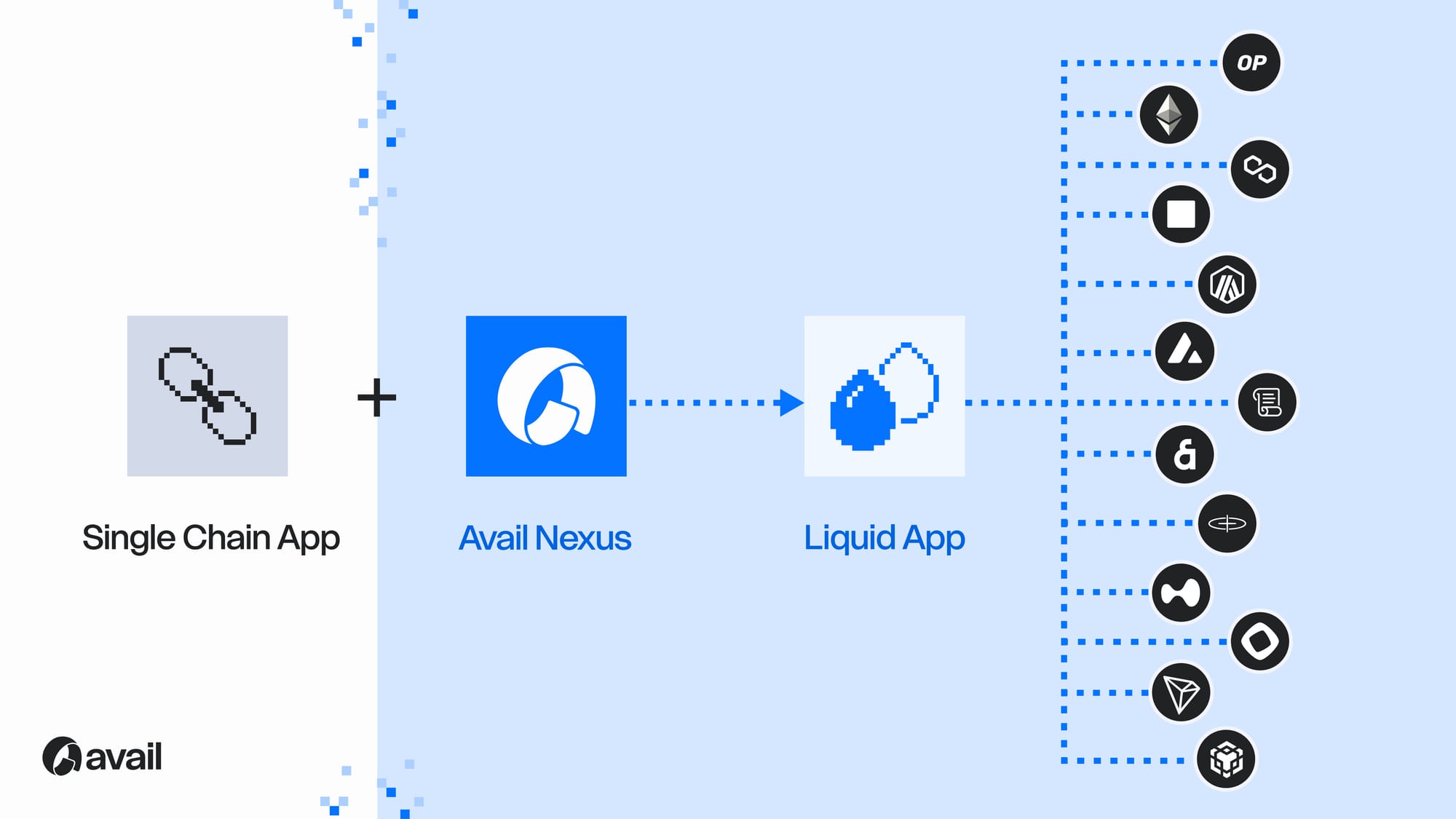
For a developer, this means you choose the chain that’s best for your app, whether for its speed, community, or tooling, all without limiting your total addressable market.
For a user, it means they can just open the app and use it. They don't need to think about which assets they hold on which chain. They simply begin using the app, and it just works. All the complexity of navigating the infrastructure is handled by the liquid app.
How Nexus Powers Liquid Apps
Avail Nexus is the coordination spine that makes Liquid Apps possible. It navigates the infrastructure, so users don’t have to.
And to be clear, Avail Nexus is not a bridge. Bridges ask users to think in terms of chains, assets and gas. Nexus abstracts all of this away. The developer integrates the Nexus SDK once, and the user never has to touch a bridge.
The Nexus SDK is added to the app's frontend, and it handles everything under the hood:
- Unifies assets across chains.
- Executes user intents across ecosystems.
- Enables apps to interact with smart contracts anywhere.
- Treats liquidity as a single, global resource.
- Handles gas, routing, and verification.
This allows developers to focus on building more powerful apps, first-class user experiences, and dramatically increase their app’s retention and engagement.
The Superpowers of Nexus
We designed Nexus to give developers and users an unfair advantage.
The key features include:
- Exact-Out Execution: Users define the exact output they need (e.g. pay $10), and Nexus calculates the required input from their assets. No more over-bridging or failed transactions.
- Multi-Input Intents: Combine assets from multiple chains into a single, seamless transaction.
- Cross-chain swap (XCS): Swap tokens at the source and destination chains, enabling users to spend X token and receive Y token wherever they need it.
- Gas Abstraction: Users can pay for transactions on any chain with the assets they already have, even if they aren't gas tokens.
- Arbitrary Function Calls: Nexus can interact with any contract on any chain, unlocking a massive design space for new app logic.
See It in Action
To experience a Liquid App, check out our Showcase App, the Monad Fast Bridge, or our live partner apps like Clober.
If you're a developer ready to build the next generation of applications, explore our plug-and-play Elements Page or dive into our docs.